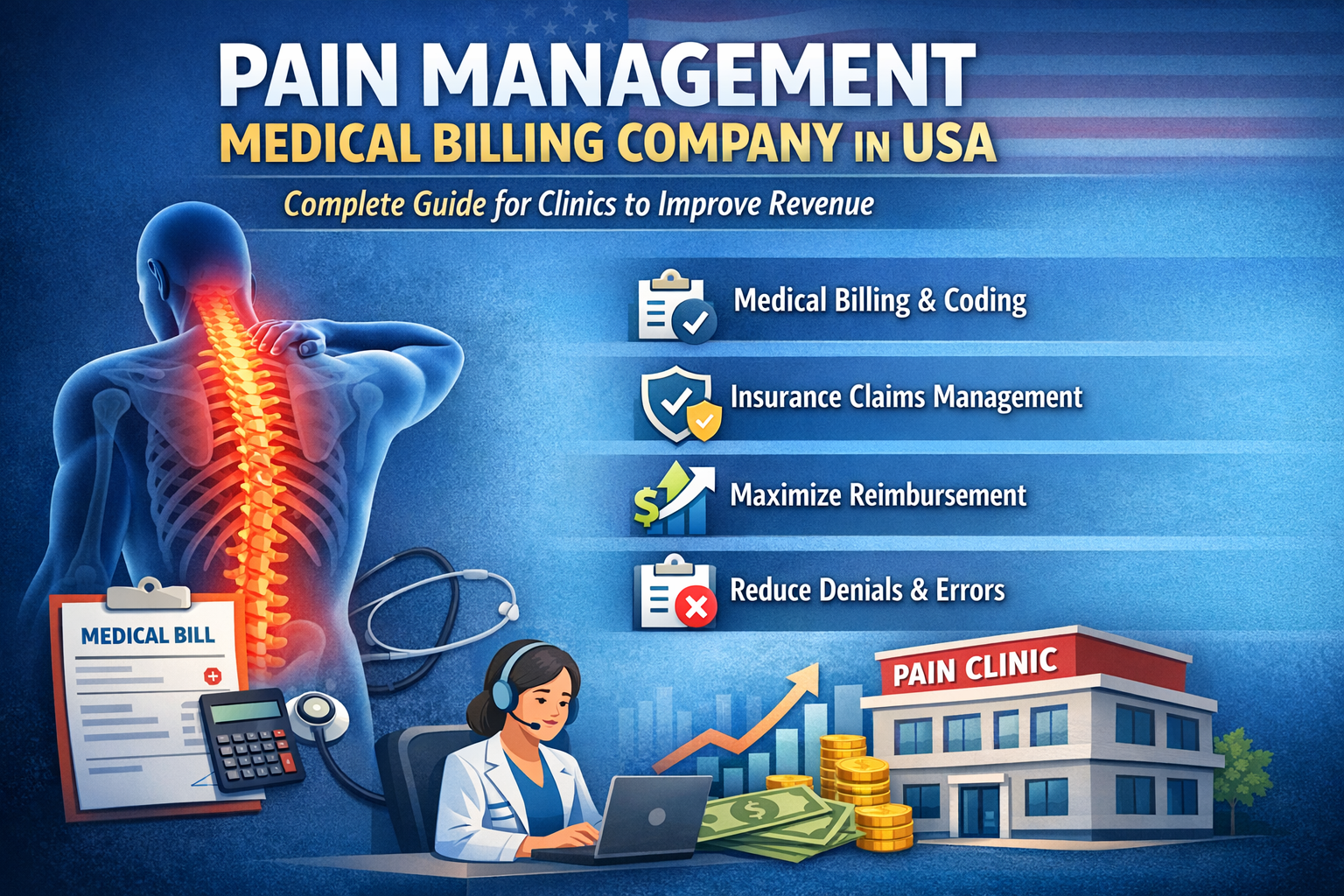
Chronic pain affects millions of patients across the United States, leading to a growing demand for specialized pain management treatments. From interventional procedures and medication management to physical therapy and behavioral care, pain specialists provide complex and multidisciplinary services. However, billing for these services can be equally complex due to strict coding requirements, payer policies, and documentation standards.
Billing for pain management services requires precise coding, proper documentation, and compliance with payer rules. Even small errors can lead to claim denials, delayed reimbursements, or compliance risks. Because of these challenges, many practices rely on specialized pain management medical billing solutions to streamline their revenue cycle and maintain financial stability.
This guide explains the essential components of billing for pain management services, the challenges providers face, and how specialized billing strategies can improve revenue performance.
Key reasons pain management billing requires specialized expertise
• Complex procedure coding
Pain management treatments often involve multiple procedures such as injections, nerve blocks, and radiofrequency ablations, each requiring accurate CPT and ICD coding.
• Strict payer policies
Insurance providers apply different rules for interventional pain procedures, requiring proper documentation and prior authorization.
• Detailed documentation requirements
Physicians must document patient history, treatment plans, imaging studies, and medical necessity to ensure claim approval.
• High denial rates without expertise
Without experienced billing teams, practices may experience denials related to coding errors, missing modifiers, or incomplete documentation.
• Ongoing regulatory updates
Coding updates and payer guideline changes require continuous monitoring to maintain compliance and accurate reimbursements.
Understanding billing for pain management services
Pain management treatments often involve complex procedures that combine diagnostic and therapeutic interventions. Providers may perform spinal injections, nerve blocks, medication management, or advanced therapies depending on patient conditions.
Billing for pain management requires accurate coding of these procedures while ensuring medical necessity is clearly documented. Proper use of CPT codes, ICD diagnosis codes, and procedure modifiers is critical to prevent claim rejections.
Pain management billing services focus on maintaining accurate coding workflows, verifying insurance coverage, handling claim submissions, and managing follow-ups with payers. These services help ensure practices receive timely reimbursements while maintaining compliance with industry standards.
Key components of pain management medical billing
Accurate coding and documentation
Pain management billing and coding services require deep knowledge of procedure coding for services such as epidural injections, facet joint injections, and spinal cord stimulation. Each procedure may involve multiple codes and modifiers depending on the treatment performed.
Proper documentation ensures that the medical necessity of each service is clearly established. Missing documentation is one of the most common reasons for claim denials in pain management medical billing.
Insurance verification and authorization
Many pain procedures require prior authorization from insurance providers. Billing teams must verify patient eligibility, confirm benefits, and obtain authorization before procedures are performed.
Pain management billing providers typically handle these tasks to ensure that procedures meet payer requirements before claims are submitted.
Claim submission and payment posting
Once services are completed, claims must be submitted accurately and quickly. Efficient claim submission reduces reimbursement delays and improves cash flow.
Pain management billing services company teams also manage payment posting and reconcile payer reimbursements to ensure all payments are correctly recorded.
Denial management and follow-up
Denials are common in pain management billing due to the complexity of procedures and payer policies. Experienced billing teams analyze denial reasons, correct errors, and resubmit claims promptly.
Pain management billing companies focus on proactive denial management strategies to recover lost revenue and improve claim acceptance rates.
Why practices choose pain management billing outsourcing
Managing billing in-house can be challenging for pain management practices due to staffing requirements and constantly changing regulations. Many providers turn to pain management billing outsourcing to improve efficiency and reduce administrative workload.
Outsourcing pain management billing allows practices to work with experienced billing specialists who understand the complexities of pain management procedures and payer requirements.
Benefits of outsourcing pain management billing services
Improved revenue cycle performance
Specialized billing teams understand how to optimize coding, documentation, and claim submission processes. This reduces errors and improves reimbursement rates.
Reduced administrative workload
Outsource pain management billing services helps physicians focus on patient care while experienced billing professionals handle insurance claims and payment processing.
Faster claim processing
Outsourcing pain management billing services ensures that claims are submitted quickly and followed up consistently, reducing payment delays.
Lower operational costs
Maintaining an in-house billing team requires training, software investments, and staff management. Pain management billing outsourcing companies offer cost-effective solutions while maintaining high accuracy.
Compliance and regulatory support
Pain management billing agency teams stay updated with payer policies and regulatory changes to ensure practices remain compliant.
How to choose the right pain management billing company
Selecting the right billing partner is crucial for maintaining financial stability and improving operational efficiency. When evaluating pain management billing companies, providers should consider several key factors.
Industry experience
A specialized pain management billing company should have experience handling complex pain procedures and payer requirements.
Advanced billing technology
Modern billing systems improve claim tracking, reporting, and denial management.
Transparent reporting
Practices should receive clear financial reports to monitor revenue performance and identify areas for improvement.
Dedicated billing specialists
Experienced pain management billing providers ensure that claims are handled by professionals familiar with pain management procedures.
Regional expertise for multi-state practices
Some providers prefer working with billing partners that understand regional payer policies. For example, practices may look for a pain management medical billing company Philadelphia, a pain management medical billing company South Jersey, or a pain management medical billing company Delaware to address local payer requirements and regulations.
Common challenges in pain management billing
Complex procedure combinations
Pain management treatments often involve multiple procedures performed during the same visit. Correct coding and modifier usage are necessary to avoid claim denials.
Frequent payer audits
Due to the high reimbursement potential of pain procedures, insurance companies frequently audit claims to ensure compliance.
Authorization delays
If prior authorization is not obtained correctly, claims may be denied even when services were medically necessary.
Incomplete documentation
Detailed clinical notes are essential for supporting procedure claims and preventing rejections.
A reliable pain management billing services company can help practices address these challenges by implementing standardized billing workflows and quality assurance processes.
Technology and analytics in pain management billing
Modern billing systems use analytics and automation to improve revenue cycle efficiency. Advanced reporting tools allow practices to monitor key performance indicators such as claim acceptance rates, denial trends, and reimbursement timelines.
Pain management medical billing teams also use electronic claim submission systems that reduce errors and accelerate payer processing.
Analytics tools help billing professionals identify recurring issues, optimize coding accuracy, and improve financial outcomes for pain management practices.
The future of pain management medical billing
Healthcare reimbursement models continue to evolve, and pain management practices must adapt to these changes. Value-based care models, stricter documentation requirements, and advanced coding updates will continue shaping billing processes.
Practices that invest in specialized billing strategies and experienced pain management billing providers will be better positioned to maintain financial stability and compliance.
Working with a reliable pain management medical billing company allows providers to focus on delivering high-quality patient care while ensuring efficient revenue cycle management.
Organizations like 247 Medical Billing Services support healthcare providers by offering comprehensive medical billing services, medical coding services, medical billing and coding services, revenue cycle management, and credentialing services. These integrated solutions help practices improve operational efficiency, reduce claim denials, and maintain consistent financial performance.
Conclusion
Billing for pain management services requires specialized knowledge, accurate coding practices, and continuous monitoring of payer policies. The complexity of pain procedures and documentation requirements makes revenue cycle management challenging for many practices.
Partnering with experienced pain management billing providers can significantly improve claim accuracy, reduce denials, and enhance overall financial performance. Whether practices manage billing internally or rely on outsourcing pain management billing, implementing efficient workflows and maintaining compliance remain essential for long-term success.
By adopting strategic billing processes and working with reliable experts, pain management practices can focus on patient care while ensuring sustainable revenue growth.
Frequently Asked Questions
What makes billing for pain management services different from other specialties?
Pain management procedures often involve complex interventions such as spinal injections and nerve blocks. These treatments require detailed coding, documentation, and payer compliance, making the billing process more complex than many other specialties.
Why do practices outsource pain management billing services?
Many providers outsource pain management billing services to reduce administrative workload, improve coding accuracy, and increase reimbursement efficiency through experienced billing specialists.
What services are included in pain management billing and coding services?
Pain management billing and coding services typically include insurance verification, prior authorization management, CPT and ICD coding, claim submission, denial management, payment posting, and revenue cycle reporting.
How do pain management billing outsourcing companies improve revenue?
Pain management billing outsourcing companies use specialized expertise, advanced billing technology, and proactive denial management strategies to improve claim acceptance rates and maximize reimbursements.
How can practices choose the best pain management billing services company?
Providers should evaluate industry experience, billing technology, transparency in reporting, and the ability to handle complex pain procedures when selecting a pain management billing services company.