


70% of Interactions by 2025: Preparing for the AI-First Future
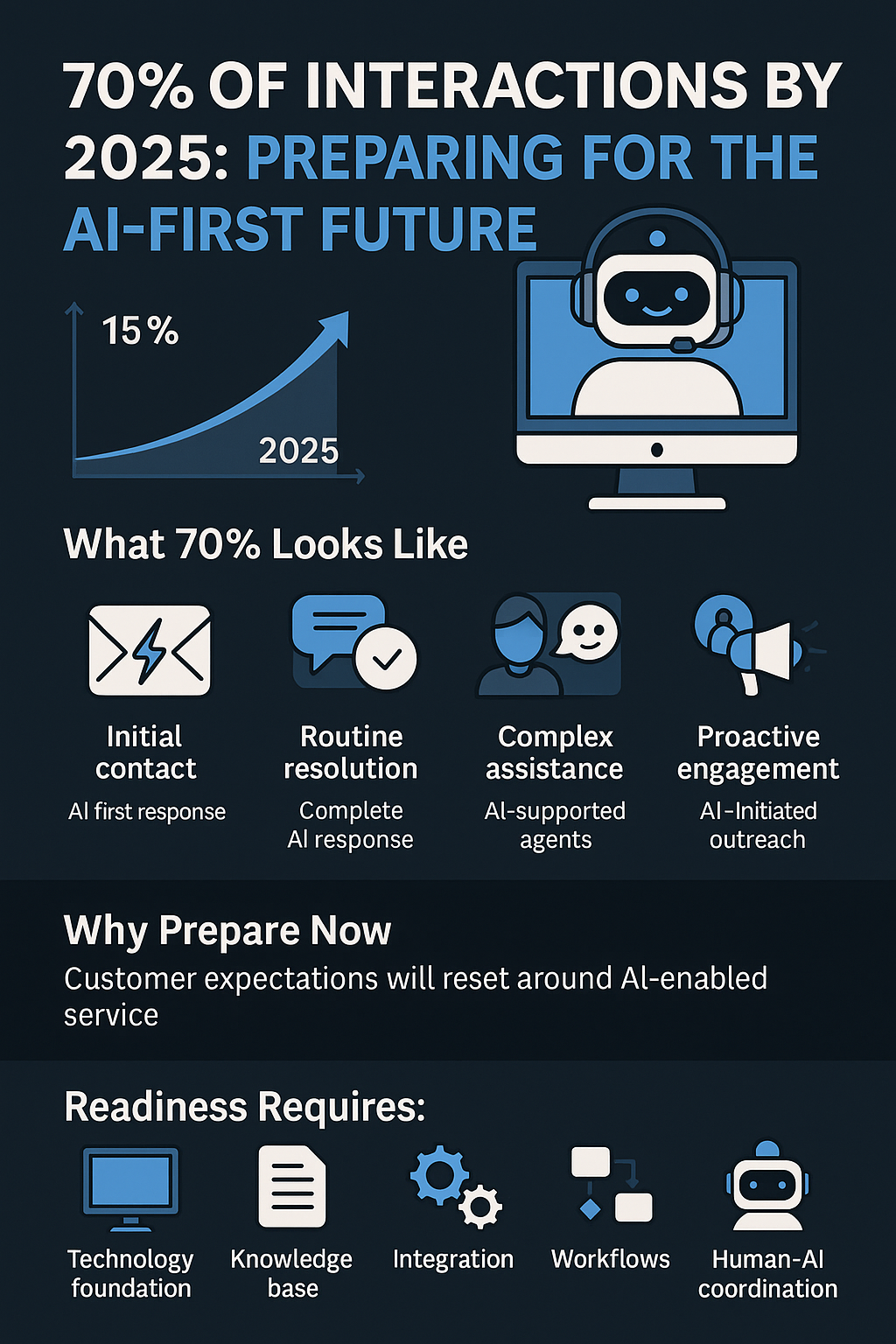
Gartner's prediction has become a planning benchmark: by 2025, 70% of customer interactions will involve AI technologies such as chatbots and virtual assistants. Up from 15% in 2020, this trajectory represents fundamental transformation in how businesses and customers connect.
For small businesses, this prediction demands preparation. The question isn't whether AI will reshape customer interaction—it's whether your business will be ready when it does.
Understanding the 70% Prediction
Gartner's projection reflects converging trends:
Technology maturation: AI capabilities have improved to handle complex interactions reliably.
Cost accessibility: Implementation costs have decreased, making AI available to businesses of all sizes.
Customer acceptance: Consumers increasingly expect and accept AI interaction when it provides value.
Competitive pressure: As adoption spreads, AI-enabled service becomes expected rather than exceptional.
The 70% doesn't mean every interaction becomes fully automated. It means AI touches 70% of interactions—handling some completely, assisting with others, providing intelligence for human-delivered service.
What 70% Looks Like
In the AI-first future Gartner predicts:
Initial contact: AI handles first response for most inquiries, providing immediate acknowledgment and routing.
Routine resolution: Common questions receive complete AI resolution without human involvement.
Complex assistance: Human agents receive AI support—relevant information, suggested responses, customer context.
Proactive engagement: AI initiates appropriate outreach based on customer behavior and needs.
The businesses prepared for this future have AI infrastructure in place. Those unprepared face competitive disadvantage as customer expectations reset around AI-enabled service standards.
The Preparation Timeline
With 2025 imminent, preparation can't be gradual. Businesses without AI implementation face compressed timelines to achieve capabilities that competitors have already developed.
McKinsey reports that AI adoption has more than doubled since 2017. Salesforce found that 51% of small businesses plan AI implementation within two years. The acceleration suggests that waiting may mean implementing under pressure rather than at deliberate pace.
Current adoption—28% of small businesses per Salesforce—will increase rapidly as the 51% planning implementation execute those plans.
What Preparation Involves
Readiness for AI-first customer interaction requires:
Technology foundation: AI platforms capable of handling customer inquiries effectively
Knowledge base: Business information organized for AI access and use
Integration: Connections between AI systems and business operations
Process adaptation: Workflows that incorporate AI capabilities appropriately
Human-AI coordination: Clear roles for AI handling versus human escalation
AI tools designed for small business provide the technology foundation with implementation approaches that don't require lengthy development timelines.
The Competitive Implications
Gartner found that 89% of companies compete primarily on customer experience. In the 70% AI world, customer experience standards will be set by AI-enabled service:
Response time measured in seconds, not hours 24/7 availability as baseline expectation Consistency across interactions as norm Personalization through AI-powered context awareness
Businesses without AI capabilities will compete against these standards using manual processes—a structural disadvantage that persists regardless of effort.
Starting Now
The path to AI readiness begins with current implementation. Businesses that implement AI now gain:
Learning time: Experience reveals optimal AI deployment before competitive pressure intensifies.
Capability building: AI improves through use; earlier implementation means more developed capability.
Customer adaptation: Existing customers adjust to AI interaction gradually rather than suddenly.
Operational refinement: Processes adapt to incorporate AI smoothly rather than disruptively.
For businesses recognizing the urgency, AI implementation for small business offers pathways that compress preparation timelines.
The 2025 Reality
Gartner's 70% prediction will prove accurate or slightly conservative. Either way, the direction is clear: AI becomes central to customer interaction across industries and business sizes.
The businesses positioned to thrive in this environment are implementing AI now—building capability while time permits rather than scrambling when the future arrives.
The future Gartner predicts isn't distant. It's the competitive landscape small businesses will navigate within months.
Catégories
- Arts & Entertainment
- Causes
- Crafts
- Dance
- Drinks
- Film
- Health
- Food Trends
- Gaming
- Home & Garden
- Health & Fitness
- Literature
- Music & Concerts
- Networking
- Autre
- Party
- Religion
- Shopping
- Sports
- Theater
- Wellness
- Cryptocurrency
- NFT Trends
- Coin update
- Lifestyle
- Business & Finance
- Entrepreneurship
- Marketing Strategies
- Personal Finance
- Investment Tips
- Industry Trends
- Technology
- Gadgets & Reviews
- Software & Apps
- Cybersecurity
- Emerging Technologies
- How-To Guides
- Éducation
- Movie & TV Reviews
- Celebrity News
- Book Reviews
- Personal Development
- Motivation & Inspiration
- Life Hacks
- Community & Culture
- Local Events
- Cultural Insights
- Social Issues
- Interviews & Spotlights
- Volunteering & Activism
- Science & Nature
- Animal Behavior
- Beauty Tips
- Fashion Trends
- Product Reviews
- Food & Drink
- Cooking
- Restaurant Reviews
- Travel
- Arts & Crafts
- Photography
- Workout Routines
- Parenting Tips
- News
- Tips & Tricks
- Case Studies
- Product Reviews
- Interviews
- Opinion
- Research & Insights
- Events Coverage
- Personal Stories
- Communiqués
- Trends & Predictions
- Guest Posts
Lire la suite
"Executive Summary North America Thermocouple Temperature Sensors Market : Data Bridge Market Research analyzes that the North America thermocouple temperature sensors market, which was USD 447.76 million in 2022, would rocket up to USD 821.27 million by 2030, and is expected to undergo a CAGR of 7.87% during the forecast period of 2023-2030. North America Thermocouple Temperature...

Five Nights at Freddy's isn't just another jump scare factory; it's a masterclass in tension, resource management, and piecing together a chilling story. Whether you're a seasoned horror fan or a newbie looking for a thrill, Fnaf offers a uniquely terrifying experience. This guide will help you navigate those haunted halls and maybe, just maybe, survive until morning. The Gameplay: Your...

Running a sweet shop is a delightful business. People love sweets for every occasion—festivals, weddings, birthdays, and even small celebrations. But to run a sweet shop legally in India, you need proper authorization from the Food Safety and Standards Authority of India (FSSAI). Getting an FSSAI registration or license is not only a legal requirement but also a mark of trust and...

In today's fast-paced digital world, the ability to update software remotely has revolutionized industries ranging from automotive to IoT devices. Over the Air Updates (OTA) are no longer a luxury but a necessity, ensuring seamless software improvements, enhanced security, and bug fixes without requiring physical intervention. What Are Over-the-Air Updates? At their core, Over the Air updates...
"Regional Overview of Executive Summary 3D Printing Elastomers Market by Size and Share The global 3D printing elastomers market size was valued at USD 281.6 million in 2025 and is expected to reach USD 1678.46 million by 2033, at a CAGR of 25.00% during the forecast period The market report also contains the drivers and restraints for the 3D Printing...