How Stablecoins Are Enabling 24/7 Global Payroll Systems
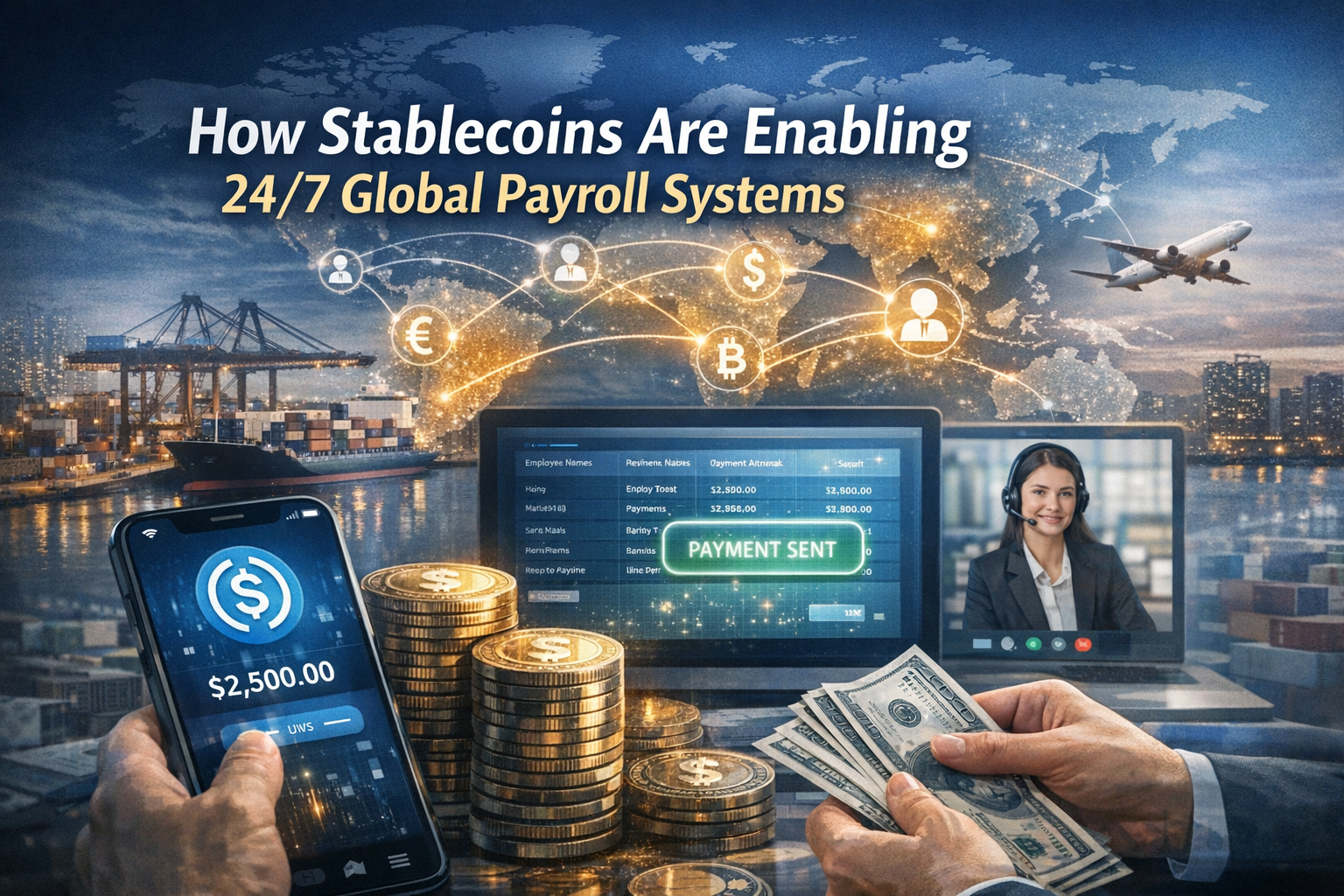
The evolution of digital finance infrastructure has fundamentally reshaped how enterprises approach cross-border compensation. Traditional payroll systems, constrained by banking hours, intermediary layers, and settlement delays, are increasingly incompatible with the demands of globally distributed workforces. Stablecoins, as blockchain-native fiat representations, are emerging as a deterministic solution for continuous, real-time payroll execution without temporal or geographic constraints.
The Structural Limitations of Traditional Payroll Systems
Legacy payroll frameworks rely heavily on correspondent banking networks, SWIFT messaging layers, and multi-stage reconciliation processes. These systems introduce latency, cost overhead, and operational friction, especially in cross-border salary disbursements.
Key inefficiencies include:
- Settlement Delays: International payroll transfers often require T+2 or longer settlement cycles due to intermediary bank dependencies.
- Foreign Exchange Volatility: Currency conversion exposure can result in inconsistent employee compensation values.
- Operational Fragmentation: Payroll execution across jurisdictions demands multiple compliance layers, increasing administrative complexity.
- Banking Hour Constraints: Transactions are restricted by regional banking schedules, preventing continuous payroll execution.
These inefficiencies highlight the necessity for a programmable, always-on financial layer capable of supporting modern workforce dynamics.
Stablecoins as a Real-Time Payroll Infrastructure
Stablecoins operate on decentralized ledger technologies, enabling atomic settlement and eliminating reliance on traditional banking rails. Pegged to fiat currencies such as USD or EUR, they maintain price stability while leveraging blockchain’s transparency and immutability.
In a payroll context, stablecoins function as:
- On-chain Settlement Units: Salaries can be disbursed instantly, with near-zero latency, irrespective of employee location.
- Programmable Payment Instruments: Smart contracts enable automated payroll triggers based on predefined conditions such as time intervals or performance metrics.
- Borderless Value Transfer Mechanisms: Transactions bypass intermediaries, reducing fees and eliminating jurisdictional bottlenecks.
Organizations exploring decentralized stablecoin development are increasingly integrating payroll logic directly into blockchain ecosystems, enabling seamless execution of recurring salary disbursements without manual intervention.
Benefits of 24/7 Global Payroll Execution
The adoption of stablecoins transforms payroll from a periodic batch process into a continuous financial workflow. This paradigm shift introduces several operational and economic advantages.
- Continuous Payment Availability: Employees can receive wages in real time, independent of weekends, holidays, or banking cutoffs.
- Reduced Transaction Costs: Eliminating intermediaries significantly lowers cross-border transfer fees.
- Enhanced Transparency: Blockchain-based payroll provides auditable transaction trails, improving compliance and accountability.
- Financial Inclusion: Workers in underbanked regions can access salaries directly via digital wallets, bypassing traditional banking infrastructure.
Additionally, stablecoin-based payroll systems facilitate micro-payments and streaming salaries, where compensation is distributed incrementally rather than in lump sums. This model aligns with emerging gig economy structures and decentralized workforce ecosystems.
Compliance, Volatility Mitigation, and Future Outlook
Despite their advantages, stablecoin payroll systems must navigate regulatory and operational challenges. Compliance frameworks vary across jurisdictions, requiring organizations to implement robust KYC (Know Your Customer) and AML (Anti-Money Laundering) protocols.
From a risk management perspective, stablecoins mitigate volatility through fiat pegging mechanisms, collateralization models, or algorithmic supply adjustments. However, maintaining peg stability and ensuring liquidity remains critical for payroll reliability.
Future developments in this domain are likely to include:
- Integration with Central Bank Digital Currencies (CBDCs): Hybrid payroll models combining stablecoins and CBDCs for enhanced regulatory alignment.
- Layer-2 Scaling Solutions: Improved transaction throughput and reduced gas fees for high-frequency payroll execution.
- Interoperability Protocols: Seamless interaction between multiple blockchain networks to support multi-currency payroll systems.
As enterprises continue to adopt decentralized financial architectures, stablecoins are positioned to become a foundational layer for global payroll infrastructure. Their ability to facilitate instantaneous, programmable, and borderless payments addresses the inherent limitations of traditional systems while aligning with the operational demands of a digital-first workforce.
Κατηγορίες
- Arts & Entertainment
- Causes
- Crafts
- Dance
- Drinks
- Film
- Health
- Food Trends
- Gaming
- Home & Garden
- Health & Fitness
- Literature
- Music & Concerts
- Networking
- άλλο
- Party
- Religion
- Shopping
- Sports
- Theater
- Wellness
- Cryptocurrency
- NFT Trends
- Coin update
- Lifestyle
- Business & Finance
- Entrepreneurship
- Marketing Strategies
- Personal Finance
- Investment Tips
- Industry Trends
- Technology
- Gadgets & Reviews
- Software & Apps
- Cybersecurity
- Emerging Technologies
- How-To Guides
- Εκπαίδευση
- Movie & TV Reviews
- Celebrity News
- Book Reviews
- Personal Development
- Motivation & Inspiration
- Life Hacks
- Community & Culture
- Local Events
- Cultural Insights
- Social Issues
- Interviews & Spotlights
- Volunteering & Activism
- Science & Nature
- Animal Behavior
- Beauty Tips
- Fashion Trends
- Product Reviews
- Food & Drink
- Cooking
- Restaurant Reviews
- Travel
- Arts & Crafts
- Photography
- Workout Routines
- Parenting Tips
- News
- Tips & Tricks
- Case Studies
- Product Reviews
- Interviews
- Opinion
- Research & Insights
- Events Coverage
- Personal Stories
- Ανακοινώσεις
- Trends & Predictions
- Guest Posts
Διαβάζω περισσότερα
"Food Additives Market - Overview, Size, Share, Industry Trends and Opportunities Global Food Additives Market, By Type (Acidulants, Anti-Caking Agents, Colours, Additives, Enzymes, Flavours, Hydrocolloids, Preservatives and Sweeteners), Source (Natural and Synthetic), Application (Bakery and Confectionery, Beverages, Convenience Foods, Dairy & Frozen Desserts, Spices, Condiments,...

Global Bromine Market – Industry Trends and Forecast to 2028 Global Bromine Derivatives Market, By Derivative (Organobromines, Bromide Salts, Hydrogen Bromide), Application (Biocides, Flame Retardants, Bromine-Based Battery, Clear Brine Fluids, Other Applications), End-Use (Automotive, Oil & Gas), Country (U.S., Canada, Mexico, Brazil, Argentina, Rest of South America, Germany,...
Die Demontage und Entsorgung von Industrieanlagen ist ein komplexer Prozess, der eine sorgfältige Planung, technisches Fachwissen und die Einhaltung gesetzlicher Umweltauflagen erfordert. Insbesondere bei der Stilllegung, Modernisierung oder Umstrukturierung von Produktionsstätten ist eine professionelle Vorgehensweise entscheidend, um Sicherheitsrisiken zu vermeiden und...

Global Wafer Carrier Tray Market, valued at a robust US$ 567.4 million in 2024, is on a trajectory of significant expansion, projected to reach US$ 934.1 million by 2032. This growth, representing a compound annual growth rate (CAGR) of 7.43%, is detailed in a comprehensive new report published by Semiconductor Insight. The study highlights the critical role of these specialized wafer...
Atlanta is a city full of energy, culture, and vibrant city life, making every visit an opportunity for excitement and sophistication. One way to elevate your experience is through an Exotic Car Rental Atlanta, which allows you to explore the city in unmatched style and performance. Imagine cruising down Peachtree Street or taking a scenic drive through the Atlanta BeltLine in a sleek...