


Speech Transcription in Healthcare Documentation Systems
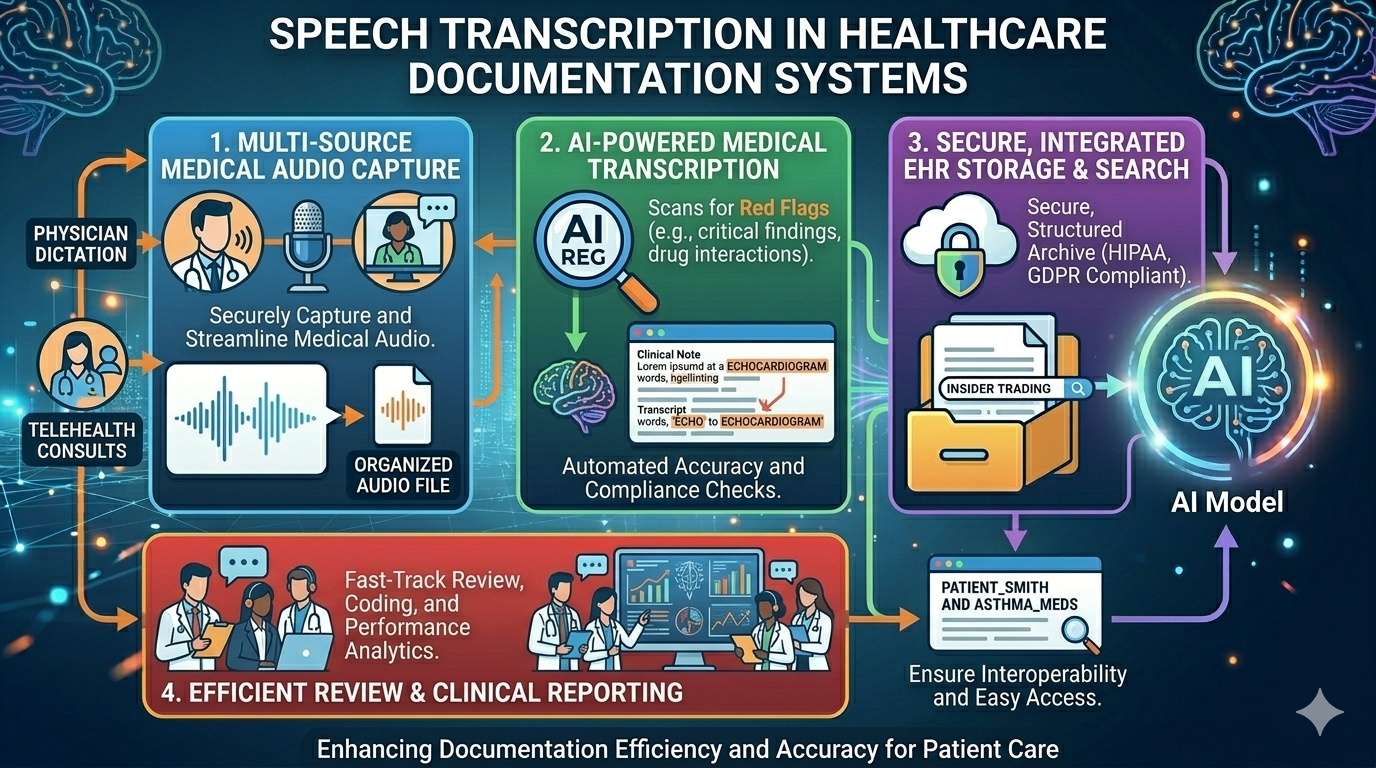
Healthcare organizations generate vast amounts of information every day—from patient consultations and clinical notes to diagnostic reports and treatment discussions. Accurate documentation is essential for delivering quality patient care, maintaining regulatory compliance, and supporting clinical decision-making. However, traditional documentation methods often require healthcare professionals to spend significant time typing notes, which can reduce time spent with patients.
This is where speech transcription plays a critical role in modern healthcare documentation systems. By converting spoken medical conversations into structured digital text, speech transcription helps healthcare providers streamline documentation workflows while maintaining high levels of accuracy and accessibility.
With the support of a reliable data annotation company like Annotera, healthcare organizations can build advanced AI-powered transcription systems using high-quality datasets and specialized annotation processes. Through data annotation outsourcing and audio annotation outsourcing, healthcare providers can accelerate the development of efficient and reliable medical documentation solutions.
The Growing Need for Efficient Healthcare Documentation
Medical professionals are required to document nearly every aspect of patient care, including medical history, diagnoses, prescriptions, treatment plans, and follow-up instructions. These records must be accurate, detailed, and accessible for future reference.
However, documentation has become one of the most time-consuming tasks for healthcare providers. Physicians often spend hours each day updating electronic health records (EHRs), creating clinical reports, and completing administrative documentation.
Speech transcription helps address this challenge by enabling healthcare professionals to dictate notes naturally while AI-powered systems convert their speech into structured text. This process significantly reduces the time spent on manual data entry and allows clinicians to focus more on patient care.
What Is Speech Transcription in Healthcare Systems?
Speech transcription refers to the process of converting spoken language into written text using speech recognition technologies and human validation processes. In healthcare environments, speech transcription is commonly used to capture:
-
Physician dictations
-
Patient consultations
-
Clinical notes
-
Radiology and pathology reports
-
Discharge summaries
-
Surgical procedure documentation
These transcripts are then integrated into healthcare documentation systems such as electronic health records. The resulting structured information improves data accessibility, enabling healthcare professionals to quickly retrieve and analyze patient information.
To build reliable medical speech recognition systems, organizations depend on high-quality annotated datasets produced through audio annotation outsourcing and expert transcription services.
Key Applications of Speech Transcription in Healthcare Documentation
1. Clinical Note Creation
Clinical notes form the foundation of patient medical records. Traditionally, physicians manually type notes after consultations, which can be time-intensive and prone to delays.
With speech transcription, clinicians can dictate notes during or immediately after patient visits. The transcription system converts the spoken information into structured text that can be automatically inserted into the patient’s electronic health record.
This approach reduces documentation time while improving the completeness and accuracy of patient records.
2. Electronic Health Record (EHR) Integration
Electronic health record systems are central to modern healthcare infrastructure. These systems store patient histories, treatment plans, laboratory results, and clinical documentation.
Speech transcription allows healthcare providers to update EHRs through voice dictation rather than manual typing. This improves efficiency and ensures that patient data is captured in real time.
Accurate transcription datasets—developed by an experienced data annotation company—are essential for training AI systems that integrate seamlessly with EHR platforms.
3. Medical Report Generation
Healthcare professionals frequently generate complex reports such as radiology findings, surgical summaries, and pathology interpretations. These reports often involve detailed medical terminology that must be accurately documented.
Speech transcription systems can convert spoken diagnostic observations into structured reports quickly and efficiently. This capability reduces turnaround time for critical reports and supports faster decision-making in clinical environments.
However, medical transcription requires specialized datasets containing domain-specific terminology. Through data annotation outsourcing, healthcare organizations can build AI models that understand complex medical vocabulary.
4. Improving Physician Productivity
Administrative workload is a major contributor to physician burnout. Doctors often spend significant time documenting patient encounters instead of focusing on clinical care.
Speech transcription improves productivity by enabling physicians to dictate notes naturally. The transcription system captures and organizes the information automatically, reducing manual documentation efforts.
By minimizing administrative burdens, healthcare providers can dedicate more time to patient care and clinical decision-making.
5. Supporting Telemedicine Documentation
Telemedicine has expanded rapidly in recent years, allowing patients to consult healthcare providers remotely through virtual platforms. These remote consultations generate large volumes of audio data that must be documented accurately.
Speech transcription systems can automatically transcribe telemedicine conversations, ensuring that patient interactions are properly recorded and stored within healthcare documentation systems.
These transcripts can also support quality assurance, training, and compliance with healthcare regulations.
6. Enhancing Medical Data Accessibility
Healthcare professionals often need quick access to patient information during diagnosis or treatment planning. Searching through audio recordings can be time-consuming and inefficient.
Speech transcription transforms spoken interactions into searchable text, enabling healthcare providers to locate specific information quickly. Physicians can search transcripts for symptoms, medications, or treatment recommendations within seconds.
This improved accessibility supports faster clinical decisions and enhances patient care.
The Role of Data Annotation in Healthcare Speech Systems
While speech recognition technologies are becoming increasingly sophisticated, their performance depends heavily on high-quality training data. Medical speech transcription presents unique challenges due to specialized terminology, varied accents, and complex clinical conversations.
A professional data annotation company plays a critical role in preparing datasets that enable accurate healthcare transcription systems.
Key annotation services include:
-
Medical speech transcription
-
Speaker labeling for doctor-patient conversations
-
Medical terminology annotation
-
Timestamp alignment for clinical recordings
-
Quality assurance and dataset validation
Through audio annotation outsourcing, healthcare organizations gain access to expert annotators who understand medical terminology and clinical workflows.
Annotera specializes in delivering high-quality annotated datasets designed to improve the performance of speech recognition models used in healthcare documentation systems.
Challenges in Healthcare Speech Transcription
Despite its advantages, implementing speech transcription in healthcare environments presents several challenges.
Data Privacy and Security
Healthcare data contains highly sensitive patient information. Organizations must ensure that transcription systems comply with strict privacy regulations and data protection standards.
Secure data handling, encryption, and controlled access are essential components of healthcare transcription workflows.
Medical Terminology Complexity
Medical language includes thousands of specialized terms, abbreviations, and diagnostic descriptions. Speech transcription systems must be trained on domain-specific datasets to accurately interpret these terms.
Multilingual and Accent Variability
Healthcare providers and patients may speak different languages or accents. Transcription systems must be capable of handling diverse speech patterns to ensure accurate documentation.
Collaborating with an experienced audio annotation company helps address these challenges by providing accurate and diverse training datasets.
The Future of Speech Transcription in Healthcare
As artificial intelligence continues to evolve, speech transcription will become even more integrated into healthcare workflows. Emerging technologies such as natural language processing (NLP) and contextual AI are enhancing the accuracy and usability of medical transcription systems.
Future healthcare documentation systems may include:
-
Real-time transcription during patient consultations
-
AI-generated clinical summaries
-
Automated medical coding and documentation
-
Voice-driven EHR navigation
These innovations will further streamline healthcare documentation while improving the quality and accessibility of medical records.
Conclusion
Healthcare documentation is essential for patient care, clinical communication, and regulatory compliance. However, traditional documentation methods can be time-consuming and inefficient for busy healthcare professionals.
Speech transcription provides a powerful solution by converting spoken medical conversations into structured digital records. This technology improves documentation efficiency, enhances data accessibility, and reduces administrative workload for healthcare providers.
However, building reliable speech transcription systems requires high-quality annotated datasets and specialized expertise. By partnering with a trusted data annotation company like Annotera, healthcare organizations can leverage data annotation outsourcing and audio annotation outsourcing to develop accurate and scalable speech transcription solutions.
As healthcare systems continue to adopt AI-driven technologies, speech transcription will play an increasingly important role in improving clinical documentation, enhancing operational efficiency, and ultimately supporting better patient outcomes.
Категории
- Arts & Entertainment
- Causes
- Crafts
- Dance
- Drinks
- Film
- Health
- Food Trends
- Gaming
- Home & Garden
- Health & Fitness
- Literature
- Music & Concerts
- Networking
- Другое
- Party
- Religion
- Shopping
- Sports
- Theater
- Wellness
- Cryptocurrency
- NFT Trends
- Coin update
- Lifestyle
- Business & Finance
- Entrepreneurship
- Marketing Strategies
- Personal Finance
- Investment Tips
- Industry Trends
- Technology
- Gadgets & Reviews
- Software & Apps
- Cybersecurity
- Emerging Technologies
- How-To Guides
- Образование
- Movie & TV Reviews
- Celebrity News
- Book Reviews
- Personal Development
- Motivation & Inspiration
- Life Hacks
- Community & Culture
- Local Events
- Cultural Insights
- Social Issues
- Interviews & Spotlights
- Volunteering & Activism
- Science & Nature
- Animal Behavior
- Beauty Tips
- Fashion Trends
- Product Reviews
- Food & Drink
- Cooking
- Restaurant Reviews
- Travel
- Arts & Crafts
- Photography
- Workout Routines
- Parenting Tips
- News
- Tips & Tricks
- Case Studies
- Product Reviews
- Interviews
- Opinion
- Research & Insights
- Events Coverage
- Personal Stories
- Последние новости
- Trends & Predictions
- Guest Posts
Больше
Unlocking Solutions: A Closer Look at the Tourette Syndrome Treatment Market Tourette Syndrome (TS) is a neurodevelopmental disorder characterized by repetitive, involuntary movements and vocalizations called tics. While there's currently no cure for TS, a dynamic and evolving treatment market offers a range of strategies to manage symptoms and improve the quality of life for individuals...

"Dental Lab Market - Overview, Size, Share, Industry Trends and Opportunities Global Dental Lab Market, By Equipment Type (Milling Equipment, Dental Scanner, 3D Printing System, CAD/CAM System, Casting Machines, Radiology Equipment, and Others), Product Type (Orthodontics, Endodontics, Restorative, Oral Care, Implants, and Prosthodontics) – Industry Trends and Forecast to 2031....
Looking for a safe and direct Instander Mod APK download? You've found the ultimate source. At getinstander.net, we provide the official, clean, and latest version of the Instander APK, straight from the developer. Say goodbye to ads, download any photo or reel, and unlock a premium Instagram experience. Why Download instander mod apk download? Instander is the most powerful...
The global Micro Data Center market is a dynamic and promising industry that has shown significant growth in recent years. According to Kings Research recent market study, the Micro Data Center market was valued at $ 6,894.6 Mn in 2022 and is expected to reach $ 29,202.7 Mn by 2030, exhibiting a robust CAGR of 20.08% over the forecast period of 2022-2030. This report provides a comprehensive...
"Executive Summary Flexible Polyvinyl Chloride (PVC) Films and Sheets Market Size and Share Analysis Report CAGR Value Data Bridge Market Research analyses that the global flexible polyvinyl chloride (PVC) films and sheets market which was USD 5.85 billion in 2022, would rocket up to USD 8.64 billion by 2030, and is expected to undergo a CAGR of 4.99% during the forecast period from 2023...
