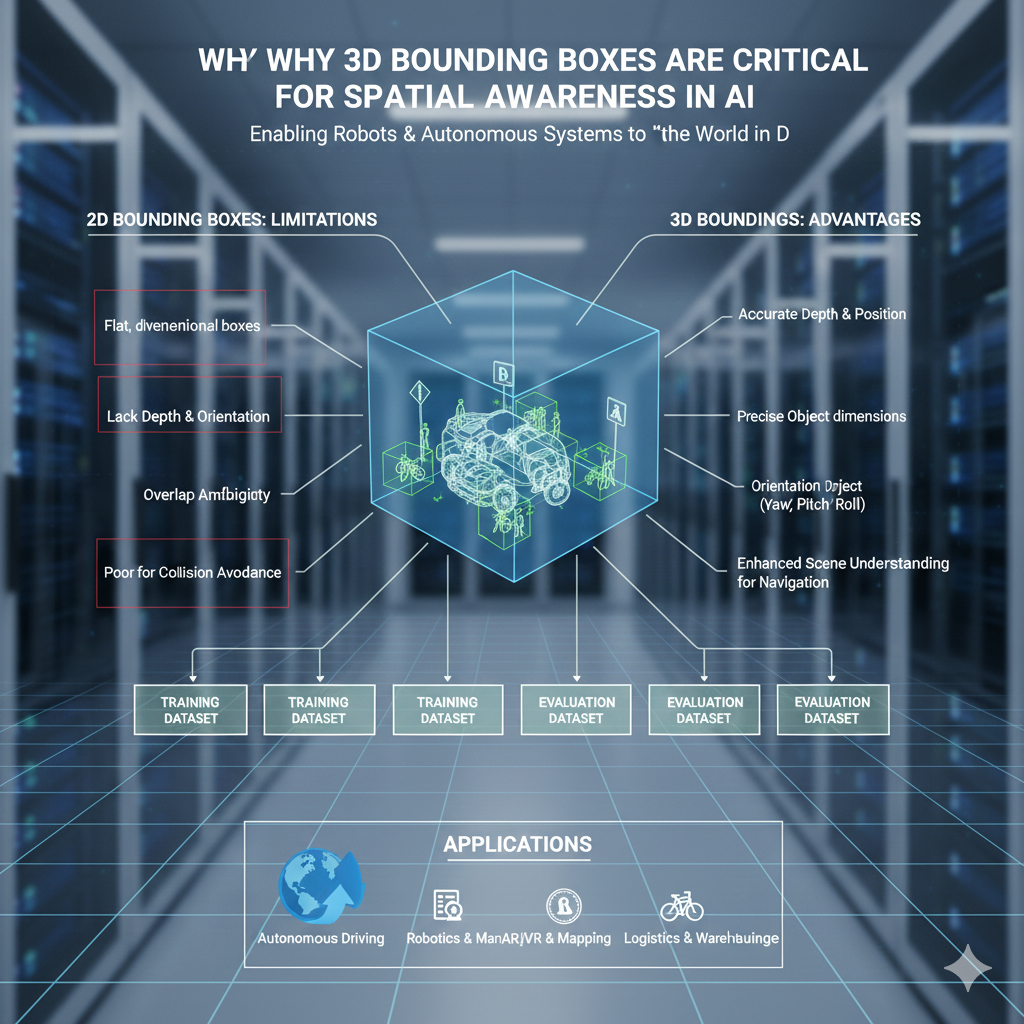
In recent years, artificial intelligence (AI) has made remarkable progress in interpreting visual data. From autonomous driving to robotics and augmented reality, machines are increasingly expected to perceive and understand the world in a way that mirrors human spatial awareness. However, achieving this level of perception requires more than traditional annotation techniques. This is where 3D bounding boxes emerge as a critical component.
As a leading data annotation company, Annotera recognizes that the shift from 2D to 3D annotation is not just an upgrade—it is a necessity for building intelligent systems that operate in real-world environments. In this article, we explore why 3D bounding boxes are indispensable for spatial awareness in AI, and how they outperform conventional approaches such as 2D Bounding Boxes.
Understanding Spatial Awareness in AI
Spatial awareness refers to an AI system’s ability to understand the position, orientation, and relationships of objects within a three-dimensional environment. Unlike flat image interpretation, spatial understanding enables machines to:
-
Estimate depth and distance
-
Predict object movement and trajectories
-
Navigate complex environments
-
Interact safely with surroundings
For example, an autonomous vehicle must not only detect a pedestrian but also determine how far away they are, whether they are moving, and if they pose an immediate risk. This level of comprehension cannot be achieved effectively with 2D Bounding Boxes alone.
What Are 3D Bounding Boxes?
3D bounding boxes are volumetric annotations that encapsulate objects within a three-dimensional space. Unlike 2D Bounding Boxes, which define objects using height and width on a flat plane, 3D bounding boxes include:
-
Length, width, and height
-
Orientation (rotation in 3D space)
-
Position in depth (distance from the sensor)
These annotations are typically generated using data from LiDAR, stereo cameras, or depth sensors, enabling a richer and more accurate representation of the environment.
Limitations of 2D Bounding Boxes
While 2D Bounding Boxes have been foundational in computer vision tasks such as object detection, they fall short when applied to real-world spatial reasoning. Some of their key limitations include:
1. Lack of Depth Information
2D annotations cannot convey how far an object is from the observer. This is a critical gap in applications like autonomous navigation.
2. Ambiguity in Object Size
An object closer to the camera may appear larger than a distant object, even if their real-world sizes are identical. 2D Bounding Boxes cannot resolve this ambiguity.
3. Poor Occlusion Handling
When objects overlap, 2D boxes often fail to accurately represent hidden portions, leading to incomplete or misleading data.
4. Limited Context Awareness
Without spatial context, AI systems struggle to understand relationships between objects, such as proximity or collision risk.
For these reasons, many advanced AI systems are transitioning toward 3D annotation methodologies.
Why 3D Bounding Boxes Are Essential
1. Accurate Depth Perception
One of the most significant advantages of 3D bounding boxes is their ability to encode depth information. This allows AI systems to determine how far objects are and make informed decisions based on distance.
In autonomous driving, for instance, depth estimation is crucial for braking, lane changes, and obstacle avoidance. Without accurate depth data, the system’s decision-making becomes unreliable.
2. Enhanced Object Localization
3D bounding boxes provide precise localization of objects in space. This includes not just where an object is, but also how it is oriented.
For robotics, this is essential. A robotic arm picking up an object must understand its exact position and orientation to interact with it correctly. 2D Bounding Boxes cannot provide this level of detail.
3. Improved Occlusion Handling
In real-world environments, objects are often partially hidden. 3D bounding boxes can infer the full volume of an object even when it is partially occluded.
This capability significantly improves detection accuracy in crowded or complex scenes, such as urban traffic or warehouse environments.
4. Better Motion Prediction
By understanding an object’s position and orientation in 3D space, AI systems can more accurately predict its movement.
For example, in a traffic scenario, knowing the orientation of a vehicle helps predict whether it will turn, stop, or continue straight. This predictive capability is critical for safety and efficiency.
5. Real-World Scale Understanding
3D bounding boxes allow AI systems to understand objects in real-world dimensions rather than pixel-based approximations.
This is particularly important in applications like construction monitoring, industrial automation, and AR/VR, where scale and proportion directly impact performance.
Applications Driving the Need for 3D Bounding Boxes
The demand for 3D annotation is growing rapidly across multiple industries:
-
Autonomous Vehicles: For navigation, collision avoidance, and path planning
-
Robotics: For object manipulation and environment interaction
-
Smart Cities: For traffic monitoring and pedestrian analysis
-
Augmented Reality: For realistic object placement and interaction
-
Healthcare Imaging: For 3D visualization of anatomical structures
In all these domains, spatial awareness is not optional—it is fundamental.
The Role of Data Annotation in 3D AI
Creating high-quality 3D bounding boxes requires specialized expertise, tools, and processes. This is where partnering with a professional data annotation company becomes critical.
At Annotera, we provide end-to-end data annotation outsourcing solutions tailored for 3D computer vision projects. Our approach includes:
-
Advanced annotation tools for LiDAR and multi-sensor data
-
Skilled annotators trained in 3D spatial labeling
-
Rigorous quality assurance protocols
-
Scalable workflows for large datasets
As an experienced image annotation company, we ensure that every annotation meets the precision required for training high-performance AI models.
Challenges in 3D Annotation
Despite its advantages, 3D annotation comes with its own set of challenges:
-
Complexity: Annotating in 3D space is significantly more complex than 2D
-
Cost: Requires specialized tools and skilled labor
-
Data Volume: 3D datasets are often large and computationally intensive
-
Standardization: Lack of uniform standards across industries
However, these challenges can be effectively managed through strategic data annotation outsourcing, enabling organizations to focus on model development rather than data preparation.
3D vs 2D: A Strategic Shift
The transition from 2D Bounding Boxes to 3D annotation represents a paradigm shift in AI development. While 2D methods remain useful for simpler tasks, they are increasingly insufficient for applications requiring real-world interaction.
Organizations investing in AI must evaluate their annotation strategies and adopt 3D approaches where spatial awareness is critical. This shift not only improves model accuracy but also unlocks new capabilities that were previously unattainable.
Why Choose Annotera?
As a trusted data annotation company, Annotera combines domain expertise with cutting-edge technology to deliver high-quality 3D annotations. Our services are designed to support:
-
Startups building AI prototypes
-
Enterprises scaling production models
-
Research teams exploring advanced computer vision
Whether you need 2D Bounding Boxes or complex 3D annotations, our data annotation outsourcing solutions ensure accuracy, scalability, and efficiency.
Conclusion
3D bounding boxes are no longer a luxury in AI—they are a necessity for achieving true spatial awareness. By providing depth, orientation, and real-world context, they enable machines to understand and interact with their environments in a meaningful way.
As industries continue to adopt AI-driven solutions, the importance of high-quality 3D annotation will only grow. Partnering with an experienced image annotation company like Annotera ensures that your AI models are built on a foundation of precise, reliable data.
In a world where perception defines performance, 3D bounding boxes are the key to unlocking the full potential of intelligent systems.